
Shares of state-owned bank stocks were under pressure on Monday due to muted deposit and credit growth numbers reported by these lenders in the October-December quarter (Q3) of 2024-25 (FY25). The Nifty PSU Bank index was down 4 per cent, with Union Bank of India emerging as the biggest loser as its shares fell 7.5 per cent to close at Rs 114.7, followed by a 5.7 per cent drop in shares of Bank of Baroda (BoB) to Rs 228 and a 4.7 per cent slide in shares of Bank of India to Rs 99.8 on the National Stock Exchange.
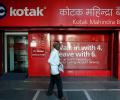
Kotak Mahindra Bank's net interest margin is likely to swell after the Reserve Bank of India (RBI) lifted its restrictions on the private lender that barred it from issuing fresh credit cards and onboarding new customers through digital mode, brokerages said on Thursday. The bank's net interest margin (NIM) has seen a decline of over 35 basis points (bps) since the restrictions were imposed by the regulator in April 2024.

Ask rediffGURU and PF expert Nitin Narkhede your mutual fund and personal finance-related questions.
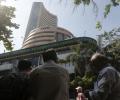
From the Sensex pack, Infosys, HCL Technologies, Infosys, NTPC, Mahindra & Mahindra, Tata Consultancy Services, Nestle, Tech Mahindra and Bajaj Finance were the major gainers. Power Grid, Larsen & Toubro, Maruti, Titan, HDFC Bank, Wipro, HDFC and ITC were among the laggards.
Ask rediffGURU and PF expert Milind Vadjikar your insurance, stocks, mutual fund and personal finance-related questions.

Purchase health insurance early while you are disease-free. 'It might become very difficult to get a comprehensive health cover for someone who has already had cancer.'

Eighty per cent, or 60 of the 75 companies that made their debut on the mainboard this financial year, ended their listing day with gains.

'Margins will be an outcome of that. They will likely remain somewhat range-bound.'

The volume of new fund offerings (NFOs) in 2025 will fluctuate based on market conditions. However, innovation is expected to continue unabated. With an increasing number of fund houses aiming to establish a presence in the 'factor' investing space and changes in fund-of-fund taxation providing more opportunities, several industry-first offerings are anticipated.

Private sector lender HDFC Bank on Thursday said the Reserve Bank of India (RBI) has asked it temporarily stop all launches of its upcoming digital business-generating activities and sourcing of new credit card customers after outage at its data centre which impacted operations last month.
Kotak Mahindra Bank was the biggest loser from the Sensex pack, skidding 1.83 per cent, followed by Axis Bank, NTPC, Hindustan Unilever, ICICI Bank, Bharti Airtel, Reliance Industries, HCL Technologies, IndusInd Bank and Nestle. In contrast, Bajaj Finance, Bajaj Finserv, Tech Mahindra, Tata Consultancy Services, Titan, Infosys, HDFC Bank, HDFC and ITC were the gainers.
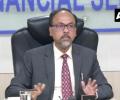
New India Assurance and Niva Bupa have invested in the Bima Sugam India Federation.
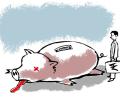
Most lenders that have reported their April-June business update posted slower growth in deposits sequentially as compared to the loan growth in the April-June quarter of 2024-25 (FY25). Current and savings account (CASA) deposits continue to face pressure. Private-sector lenders YES Bank, Bandhan Bank, and RBL Bank saw their deposit growth contract by 0.5 per cent, 1.5 per cent, and 2 per cent, respectively.

Market players attribute the rally in small and midcaps to flows from retail investors and domestic institutions.

These 10 stocks represent the best mix of value and growth, offering relatively low price-to-earnings and price-to-book ratios, a high return on equity, and sufficiently high potential from current levels.

Kotak Mahindra Bank was the biggest loser in the Sensex pack, sliding 2.68 per cent, followed by Tech Mahindra, Mahindra & Mahindra, Axis Bank, Hindustan Unilever, Tata Motors, Tata Consultancy Services, Bajaj Finserv, Bajaj Finance, Nestle and Titan. In contrast, NTPC, Power Grid, Larsen & Toubro, HDFC, Reliance and HDFC Bank were the gainers.

Among the Sensex firms, Axis Bank, Power Grid, Maruti, State Bank of India, Tata Motors, ITC, Nestle and Mahindra & Mahindra were the major gainers. Bajaj Finance and Larsen & Toubro were the laggards.

Equity indices failed to hold on to morning gains on Tuesday, with the Sensex falling 236 points amid a sell-off in IT stocks and weak trends from global markets. The 30-share BSE benchmark opened higher but could not carry forward the momentum and declined 236 points or 0.43 per cent to settle at 54,052.61. During the day, it hit a low of 53,886.28 and a high of 54,524.37. The broader NSE Nifty dropped 89.55 points or 0.55 per cent to end at 16,125.15.

While discount brokers have managed to grow at a rapid pace, they have not been successful in capturing substantial market share in the above-40 age category.

If raters get away by moving from AAA to D overnight after companies default, as happened with DHFL, YES Bank, RCom, and IL&FS, it shows a complete breakdown in the rating system. It calls for exemplary punishment, not kid glove treatment, says Debashis Basu.

Investors' wealth tumbled over Rs 5.78 lakh crore in two days of market fall amid a weak trend in global markets after a host of central banks hiked interest rates and gave hawkish commentary. The 30-share BSE Sensex declined 461.22 points or 0.75 per cent to settle at 61,337.81 on Friday. In the previous trade, the BSE benchmark had tanked 878.88 points or 1.40 per cent to settle at 61,799.03.

Do you have financial planning or income tax queries? Ask rediffGURU Anil Rego.

A day after the Reserve Bank of India (RBI) lifted its ban on HDFC Bank on issuing new credit cards, the country's largest private sector lender on Wednesday said it had resources and plans in place to "further reinforce pole position in the credit card segment" and that it would "come back with a bang". "We will aggressively go to the market, with not just our existing suite of credit cards but also new offerings in the form of co-brands and partnerships," Sashidhar Jagdishan, managing director and chief executive officer of HDFC Bank, said in a letter to his employees. The bank's management had earlier indicated that the lender had been sourcing liability customers aggressively over the past few months.

Credit card spending reached Rs 2 trillion in October, a 14.5 per cent rise from September, largely driven by festival season purchases. However, the volume of outstanding credit cards increased only marginally during the same period. The spike in spending comes at a time when nearly all major credit card issuers are calibrating their growth in the segment due to visible signs of stress.

Major credit issuers, including the largest - HDFC Bank - have integrated their systems with the Bharat Bill Payment Systems (BBPS) for receiving credit card repayments via third-party applications.

The revenue growth of early birds or companies that have declared their Q4FY24 (March quarter) numbers is the highest in the last four quarters. The 178 companies (excluding their listed subsidiaries) that declared their results have reported a sales growth rate of 13.2 per cent year-on-year (Y-o-Y), taking aggregate revenue to Rs 9.1 trillion. Including other income, growth is at 16 per cent, the highest in the last four quarters.

The BSE gauge Sensex tanked over 1,500 points to crack below the 57,000-mark and the NSE Nifty slipped below the 17,000-level in the opening session on Monday, amid heightened tension over the Russia-Ukraine conflict. The 30-share Sensex nosedived 1,540.85 points to 56,612.07 in early deals and the broader Nifty plummeted 458.20 points to 16,916.55. On the Sensex chart, all 30 shares were trading with steep to moderate losses -- with SBI, Tata Steel and IndusInd Bank tumbling over 4 per cent.

'There is more expansion in the industry happening in retail lines, so we will continue to focus on those lines.'

Apart from navigating the bank through the Covid crisis, Jagdishan may also have to deal with the latest development on the auto loan lending practice scam. He will be expected to deliver consistent profit growth of 20 per cent-plus quarter after quarter, irrespective of the operating environment.
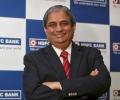
Tamal Bandyopadhyay details HDFC Bank's digital journey.

'We need people who can position a product digitally and craft the journey for customers, by improving user interface and user experience.'
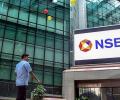
The benchmark National Stock Exchange Nifty has rallied 4 per cent, or 750 points, from this month's low to end at 19,732 on week ending November 17. Technical analysts say the market could consolidate around the current levels as it is nearing the resistance zone. "The near-term uptrend status of the market remains intact, but there is a possibility of some more consolidation or minor weakness for the Nifty in the next one to two sessions.

Paytm, the country's leading fintech player which had to shut its payment bank business following regulatory action, is revisiting its business strategy including partnership with lenders. Also, the company's founder and chief executive officer (CEO) Vijay Shekhar Sharma has decided to oversee the day-to-day operations with all the major verticals reporting directly to him now. "The thing on top of everyone's agenda is getting the core businesses back on track," a person in the know said.

India's financial sector is dominated by large government-owned and private-sector banks.

Before heading abroad, ensure your travel insurance policy offers all essential coverage and has an adequate sum insured.

'Asset allocation should be driven much more by long-term factors rather than the market scenario at any particular point in time.'
Housing finance major HDFC on Monday reported a 16 per cent growth in standalone net profit to Rs 3,700 crore for the January-March quarter, helped by record loan sales on the back of benign interest rates and the resultant fall in cost of funds along with the near-total repayments that culled provisions and credit costs. For the full year, the company, which is working on a reverse merger with its banking subsidiary, has booked a net profit of Rs 13,742 crore, up from Rs 12,027 crore in FY21, vice-chairman and chief executive Keki Mistry said on Monday in an earnings call with analysts. On a consolidated basis, net profit for the quarter surged 21.6 per cent to Rs 6,892 crore on-year and for the full year it jumped 21 per cent to Rs 22,595 crore, Mistry said and guided towards better days.

The Rs 6,145-crore initial public offer of electric two-wheeler company Ola Electric Mobility got fully subscribed on the second day of bidding on Monday, driven by demand from retail investors and non-institutional investors. The initial share sale received bids for 49,43,63,610 shares against 46,51,59,451 shares on offer, translating into 1.06 times subscription, according to the NSE data.

Public-sector banks, including Canara Bank and Bank of India, are tapping the infrastructure bond market. Canara Bank on Tuesday raised Rs 10,000 crore at a coupon rate of 7.40 per cent through 10-year infrastructure bonds. This comes after SBI on July 10 raised Rs 10,000 crore also through infrastructure bonds with a 15-year tenor at a coupon rate of 7.36 per cent.

The Nifty IT has been one of the worst-performing indices on the bourses this calendar year. Rising concerns of a potential global recession, which investors fear can dampen demand for export-facing domestic information technology (IT) giants, have sent the index down over 30 per cent on a year-to-date basis. By comparison, the Nifty50 Index has shed 2.8 per cent during the period, reveals data by ACE Equity.
